
Dr Nagesh Kumar, one of the three new MPC members, wanted the MPC to reduce the repo rate by 25 basis points to 6.25%.

Equity markets fell on Monday, with benchmark indices recording their worst session in over two months amid caution ahead of the US Federal Reserve's (Fed's) policy announcement and renewed uncertainty over the US-India trade deal. Sustained selling by foreign portfolio investors (FPIs) also weighed on sentiment.

RBI Governor Subbarao has recently indicated that it cannot ignore inflationary signals.

Home purchase affordability has improved in the first half of calendar year (CY) 2025, after the RBI reduced the repo rate by 100 basis points (bps), according to real estate consultancy Knight Frank India.

The Indian banking sector could be due for a rise in profitability after several quarters of net interest margin (NIM) compression. The Q2FY26 results suggest NIMs have bottomed out.

India was being evaluated for a potential weight of around 1 per cent in the index, an allocation that could have translated into $25 billion of inflows, spread over roughly 10 months.

A day after his appointment as the 26th governor of the Reserve Bank of India (RBI), outgoing Revenue Secretary Sanjay Malhotra on Tuesday said one must understand the economic landscape and do what was best for the economy. "Let me first go, join, understand the turf ... Here it is a different role," Malhotra said, speaking to reporters in front of North Block.

Wholesale price inflation (WPI) returned to the positive zone after two months at 0.52 per cent in August, as prices of food articles and manufactured items inched up, government data showed on Monday. WPI-based inflation was (-) 0.58 and (-) 0.19 per cent in July and June, respectively.

Reserve Bank on Friday decided to cut Cash Reserve Ratio (CRR) by a huge 1 per cent, which will unlock Rs 2.5 lakh crore liquidity to the banking system for lending to productive sectors of the economy. With the reduction in four equal tranches ending November 29, 2025, the CRR would come down to 3 per cent.

RBI Governor Raghuram Rajan asked banks to follow suit and pass on the rate cuts.

Nudging the RBI to cut interest rates to boost growth, Finance Minister Arun Jaitley on Sunday said he had already made his mind clear and hoped the central bank will take decision after taking into account various factors.

Sanjay Malhotra takes charge as the 26th RBI governor at a time when headline retail inflation has shot up to 6.2%.
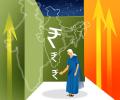
S&P Global Ratings on Tuesday retained India's growth forecast at 6.8 per cent for the current fiscal and said it expects the RBI to start cutting interest rates in its October monetary policy review. In the economic outlook of Asia Pacific, S&P Global Ratings also retained its GDP growth forecast for the 2025-26 fiscal at 6.9 per cent and said solid growth in India will allow the Reserve Bank to focus on bringing inflation in line with its target.

Reducing policy rates is not enough. The key is to ensure banks lend to credit-constrained borrowers.

The Indian government has expressed its disagreement with the IMF staff's 'baseline' assumption that the 50 per cent US tariffs on its goods exports 'would remain in place indefinitely', based on which the staff pegged the country's GDP growth at 6.6 per cent this year, and pared its 2026-27 projection by 20 basis points to 6.2 per cent.

Reserve Bank of India (RBI) Governor Sanjay Malhotra said the repo rate cut in the February meeting of the monetary policy committee (MPC) was due to inflation aligning with the target and recognising the fact that monetary policy is forward-looking.
In the last three years, public sector banks have responded to the RBI's policy rates more strongly than private banks.

As deposit growth lags credit expansion, Indian banks face shrinking low-cost Casa inflows, rising funding costs, and structural shifts driven by UPI, e-Kuber, and digital savings trends, points out Tamal Bandyopadhyay.

Retail inflation inched up to 0.71 per cent in November on rising prices of vegetables, protein-rich items, and fuel, government data showed on Friday. The consumer price index (CPI)-based retail inflation had fallen to a record low of 0.25 per cent in October, mainly due to lower prices helped by GST rate cuts and a favourable base.
.jpg)
Markets ended tad lower with financials declining the most ahead of RBI policy review tomorrow.

India Inc on Tuesday expressed disappointment over the Reserve Bank increasing the key rate by 0.25 per cent and hoped that banks would refrain from hiking lending rates as such a move will scuttle economic recovery.

The Reserve Bank of India's tight monetary policy is expected to moderate India's economic growth rate to 8.1-8.6 per cent in 2008, against 8.5-9 per cent in 2007, Global rating agency Standard and Poor's said on Wednesday.

The NSE Nifty, after shuttling between 10,698.35 and 10,587.50, finished the session 91.50 points, or 0.86 per cent higher at 10,684.65.

Titan, Nestle, Hindustan Unilever, State Bank of India, Larsen & Toubro, ITC, Zomato and Bajaj Finserv were also among the laggards. Adani Ports, IndusInd Bank, Tata Motors and HDFC Bank were among the major gainers.

Wholesale price inflation (WPI) stayed in negative territory for the second consecutive month at (-) 0.58 per cent in July, as prices of food articles and fuel saw deflation, even though prices of manufactured items increased, government data showed on Thursday.

The policy guidance marks a clear shift in RBI's monetary policy stance towards addressing growth risks while not de-emphasising the objective of containing inflation

"We are contributing about 18 per cent, which is more than the US where the contribution is expected to be much less -- about 11 per cent or something. We are doing very well and we will continue to improve further," RBI governor Sanjay Malhotra said, replying to a question on Trump's recent comments.

Borrowers should consider switching from an MCLR-linked to a repo rate-linked loan.
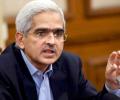
The December meeting of the Reserve Bank of India's (RBI's) six-member Monetary Policy Committee (MPC) will start on Wednesday even as there is no clarity on whether Governor Shaktikanta Das, the chair of the panel, will continue in office after his term ends next week. The outcome of the meeting will be announced on Friday by Das at 10 in the morning.

The RBI is fully aware that the high-cost loans and high indebtedness of the borrowers could pose financial stability risks, if not addressed by these NBFCs. Governor Shaktikanta Das has issued a stern warning, saying the RBI is closely monitoring these areas and will not hesitate to take appropriate action, if necessary, if the culprits don't opt for self-correction. Watch out for some action, soon, notes Tamal Bandyopadhyay.

After raising interest rate by a cumulative 250 basis points in 11 months, the Reserve Bank of India (RBI) on Thursday unexpectedly kept benchmark rate unchanged as global banking woes added uncertainty to the economic outlook. Five out of six members of MPC voted to remain focused on the withdrawal of accommodation to ensure inflation aligns with target while focusing on growth, RBI Governor Shaktikanta Das said on Thursday. The Monetary Policy Committee of the central bank decided to take a pause after a rate hike seen in previous six consecutive policies.
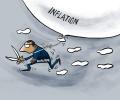
Wholesale price based inflation declined to a 3-month low of 1.89 per cent in November on cheaper food items, and experts predicted a 0.25 per cent interest rate cut by the RBI in the policy review in February. The Wholesale Price Index (WPI) based inflation was 2.36 per cent in October 2024. It was 0.39 per cent in November, last year. In August, 2024, it was 1.25 per cent.

Equity markets this week will turn their focus on the RBI's interest rate decision, Q1 earnings from several blue-chip firms and tariff-related news for further cues, analysts said. Moreover, trading activity of foreign investors and trends in global equity markets will also drive investors' sentiment.
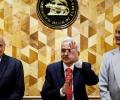
'The central bank has highlighted that the slowdown in growth has been limited to a few sectors and overall growth is expected to pick up in the second half of the year.'

Reserve Bank Governor Shaktikanta Das on Friday said that this stage would have been "premature" and "very very risky" as the retail inflation is still high, and future monetary policy action would depend upon the income data and outlook. Earlier this month, the RBI continued to maintain the status quo in the short-term lending interest rate (repo), citing inflationary concerns, though it changed the monetary policy stance to neutral.
With concern on food inflation ebbing with the monsoon progressing well, the Reserve Bank of India (RBI) is warming up to the idea of a change in stance to "neutral" from "withdrawal of accommodation", according to economists. In his speech on Thursday during the annual event of the Federation of Indian Chambers of Commerce and Industry-Indian Banks' Association, RBI Governor Shaktikanta Das said: "The balance between inflation and growth is well-poised."

In the mid-quarter review on December 18, the Reserve Bank left key policy rates unchanged but said it will hike interest rates if inflation does not subside.
The Reserve Bank is likely to maintain status quo on interest rates in its forthcoming monetary policy review but may change the stance in view of retail inflation piercing its upper tolerance limit, global uncertainties created by the ongoing Russia-Ukraine war, and the urgency to protect and boost growth, feel experts. The RBI governor-headed rate setting panel -- Monetary Policy Committee (MPC) -- will be holding its first meeting of the 2022-23 fiscal from April 6 to 8. The outcome will be announced on April 8.

RBI's fifth bi-monthly monetary policy meet due tomorrow also kept the investors on their toes.
The Reserve Bank may be hitting the end of its tolerance for high inflation and will most likely hike interest rates in the first half of 2022, analysts said on Friday. The central bank will also start rolling back its accommodative policies which have led to easy liquidity conditions, they said. The view from analysts came even as inflation cooled down to 5.6 per cent for July, after two months of breaching the upper end of the RBI's tolerance band of 6 per cent.
